
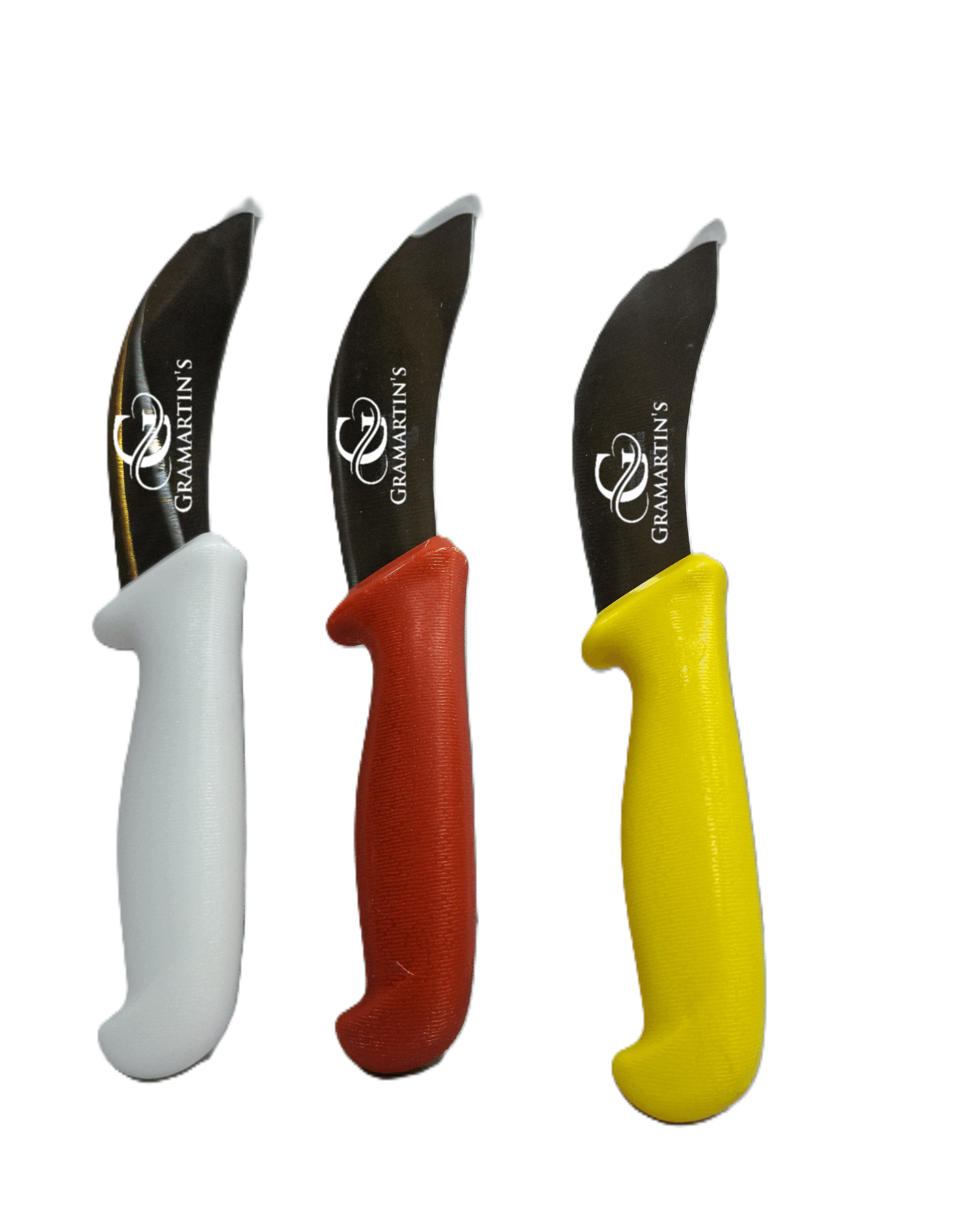
Among your butchering tools should be a skinning knife. Skinning a large animal merely requires separating the hide from the meat by cutting the membrane that connects them. Generally, the faster you can remove the hide, the quicker the meat cools and the better it will taste.
Every successful hunter has an opinion and here’s what I look for in a skinning knife:
- Thin blade: The knife is not going to be used for bushcraft, and woodworking is not in the plan. A thin blade is more effective for virtually everything.
- Pronounced belly: The belly of a blade is that part from the tip to where the edge straightens out. The belly does most of the work, and a skinning knife will have a large belly with a curve.
- Comfortable handle: A skinner will be used a lot, for extended periods of time. The handle that fits your hand allows you to work comfortably. (Here is how to measure your hand to fit a handle.)
- Quality steel: This goes without saying. A knife that must frequently be re-sharpened will take more time to use. Also, it will dull quicker, making it an unsafe tool. Best steel
- Point: A piercing or drop point will work OK for skinning, but the best is an upswept or trailing point. These help extend the belly of the blade.
- Size: This is a personal choice. I usually take two different-sized skinners in my daypack, because I can. I want a five-to-six inch blade on the larger knife, and a smaller knife with a two-to-three inch blade. These will be used in different parts of carcass.
- No replaceable blades: Your best chance for getting in a survival situation is when you’re big game hunting. The replaceable blade knives are not sturdy enough to be survival knives, and finding replacement blades could be impossible. And are you going to pack out the dull blades? I hope so. Invest in a quality knife with good steel, and you won’t need to be resharpening or switching blades while processing a carcass.



Reviews
There are no reviews yet.